

Product mix pricing strategies are important for businesses that offer multiple products instead of a single item. Pricing decisions become more complex when products are interrelated, as companies must consider the overall profitability of the entire product mix rather than individual products.
Product mix pricing strategy is a strategy used to set product prices. When a product is part of a product mix, the strategy for determining its price often changes.
In such situations, the business organization searches for a group of prices that maximizes profits across the entire product mix.
Why Product Mix Pricing is Important
Before discussing the different strategies, include a short paragraph explaining that product mix pricing helps businesses optimize revenue across related products rather than maximizing the profit of a single item.
Explain that organizations use these strategies to encourage customers to purchase complementary products, improve product line profitability, and increase overall customer value.
Types of Product Mix Pricing Strategies with Examples
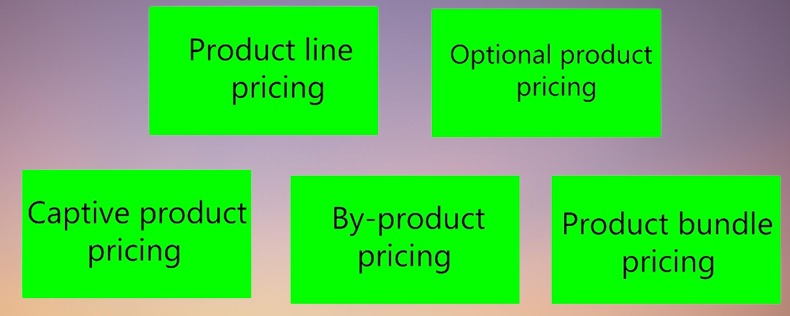
Since different products have related costs, demand levels, and varying degrees of competition, pricing becomes more challenging. Following are the five product mix pricing strategies you need to know while setting prices.
| Strategy | Purpose |
|---|---|
| Product Line Pricing | Set prices across a range of related products |
| Optional Product Pricing | Price optional or accessory products separately |
| Captive Product Pricing | Price essential companion products for continued use |
| By-Product Pricing | Generate revenue from by-products |
| Product Bundle Pricing | Combine multiple products into a single package at a combined price |
1. Product Line Pricing
Business organizations usually develop product lines rather than offering a single product. In product line pricing, management must decide on appropriate price differences between products within the same line.
While setting these price steps, the organization must consider:
- Cost differences between products
- Competitor pricing
- Customer perceptions of product features
Many industries use clearly defined price points for products within a line. The seller’s responsibility is to ensure that perceived quality differences justify the differences in price.
2. Optional-Product Pricing
Optional product pricing is used by businesses that offer optional or accessory products along with the main product.
For example, a car buyer may choose additional features such as cruise control, power windows, or a CD changer. Pricing these options can be challenging, as companies must decide which features to include in the base price and which to offer as add-ons.
In the past, some base models lacked too many essential features, which led to reduced customer interest. Therefore, businesses must carefully balance what is included and what is optional to meet customer expectations.
3. Captive-Product Pricing
Captive product pricing is used when a product must be used together with another main product.
Examples include:
- Camera film
- Computer software
- Razor blades
- Video games
Manufacturers often price the main product at a lower level and earn higher profits from the required supplies or accessories. For example, a camera may be sold at a lower price, while the company generates profit from selling film.
In service industries, this approach is known as two-part pricing. The total price is divided into:
- A fixed fee (such as a monthly subscription)
- A variable usage charge (such as charges per usage)
The fixed fee should be low enough to encourage usage, while profits are generated through variable charges.
4. By-Product Pricing
By-products are often produced during the manufacturing of goods such as petroleum products, processed meats, and chemicals.
Sometimes, these by-products have little value, and disposing of them can be costly. In such cases, companies try to find a market for these by-products and sell them at any price that covers storage and delivery costs.
This approach helps reduce the overall cost of the main product, making it more competitive.
In some situations, by-products can even become profitable. However, businesses may not always recognize the potential value of their by-products.
5. Product Bundle Pricing
In product bundle pricing, businesses combine several products and offer them at a lower price than if each item were purchased separately.
For example, this strategy is commonly used in:
- Sports events (season tickets)
- Hotels (packages including meals, rooms, and entertainment)
- Software companies (bundled software packages)
Bundling encourages customers to purchase products they might not buy individually. However, the combined price must be attractive enough to provide value to the customer.
Example of Product Mix Pricing
Suppose a smartphone manufacturer offers several models within the same product line.
The company prices its entry-level model for budget-conscious customers, its mid-range model for average consumers, and its premium model for users seeking advanced features. Additional accessories such as wireless earbuds and protective cases are sold separately using optional product pricing, while charging subscriptions for cloud storage represent captive product pricing. During holiday promotions, the company bundles smartphones with accessories at a discounted package price.
This example helps readers understand how several product mix pricing strategies can be applied simultaneously.
Frequently Asked Questions (FAQs)
What is product mix pricing?
Product mix pricing is a pricing strategy in which businesses determine prices for groups of related products rather than pricing each product independently.
What are the major product mix pricing strategies?
The major strategies include product line pricing, optional product pricing, captive product pricing, by-product pricing, and product bundle pricing.
Why is product mix pricing important?
It helps organizations maximize overall profitability, encourage complementary purchases, improve customer value, and strengthen marketing performance.
What is product bundle pricing?
Product bundle pricing involves offering multiple related products together at a combined price that is usually lower than purchasing each product separately.
How has technology changed product mix pricing?
Technology enables businesses to analyze customer behavior, create personalized product bundles, recommend complementary products, and optimize pricing through artificial intelligence and data analytics.
Conclusion
Product mix pricing strategies enable organizations to maximize the value of their entire product portfolio rather than focusing on individual products. By carefully coordinating prices across related products, businesses can improve profitability, strengthen customer satisfaction, and encourage additional purchases.
As digital technologies continue to influence pricing decisions, organizations increasingly use customer data, artificial intelligence, and personalized recommendations to optimize product mix pricing. Businesses that effectively manage product relationships through strategic pricing are better positioned to achieve long-term marketing success.
Read More: How to Set Pricing Strategy