

Employment tests are used to measure differences among individuals in relation to job performance. These differences may relate to cognitive abilities, psychomotor skills, job knowledge, personality, vocational interests, and other work-related characteristics.
Organizations use employment tests to evaluate candidates objectively and ensure that the most suitable individuals are selected for specific roles. These tests help assess a candidate’s ability to perform tasks effectively and contribute to organizational success.
Why Employment Tests are Important
Selecting the right employees is one of the most important responsibilities of Human Resource Management. While resumes and interviews provide valuable information, they may not always accurately predict future job performance.
Employment tests help organizations evaluate candidates objectively by measuring abilities, skills, knowledge, personality traits, and job-related competencies. These assessments improve hiring accuracy, reduce recruitment risks, and increase the likelihood of selecting candidates who are well suited to the job.
When combined with interviews and other selection methods, employment tests contribute to more informed and reliable hiring decisions.
Key Facts About Employment Tests
| Aspect | Description |
|---|---|
| Definition | Standardized assessments used during employee selection |
| Purpose | Evaluate candidate suitability |
| Conducted During | Recruitment and selection |
| Users | HR professionals and hiring managers |
| Benefit | Improves hiring quality and objectivity |
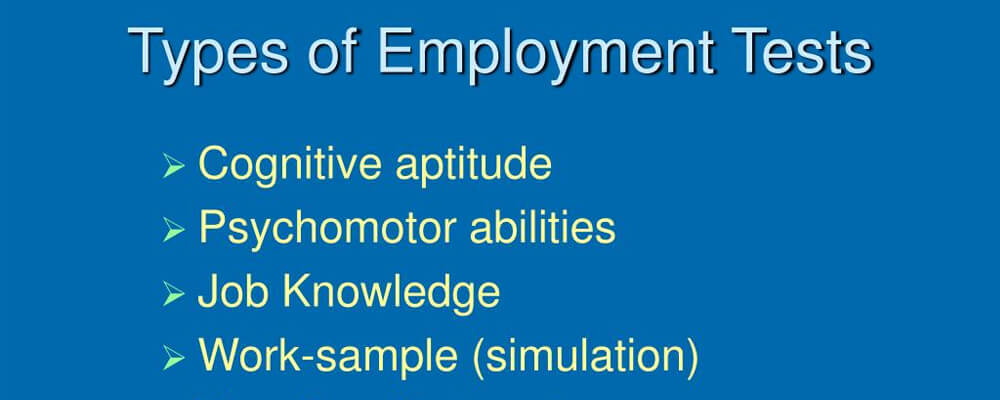
Types of Employment Tests
1. Cognitive Aptitude Tests
Cognitive aptitude tests evaluate a person’s ability to learn and perform job-related tasks.
These tests measure abilities such as numerical skills, verbal skills, reasoning, perceptual speed, and spatial understanding. They are widely used to predict future job performance.
2. Psychomotor Abilities Tests
Psychomotor tests measure coordination, strength, and dexterity.
They are useful for evaluating abilities required in jobs that involve physical activity, manual tasks, or routine production work, as well as some office-related roles.
3. Job Knowledge Tests
Job knowledge tests assess a candidate’s understanding of specific tasks related to the job.
These tests are designed to determine whether the candidate possesses the required knowledge to perform the job effectively.
4. Work-Sample Tests
Work-sample tests require candidates to perform tasks that are similar to actual job duties.
These tests provide a realistic evaluation of a candidate’s ability by observing how they handle job-related tasks.
5. Vocational Interest Tests
Vocational interest tests identify the types of occupations in which an individual is most interested.
They help determine the likelihood of job satisfaction and long-term engagement in a particular career.
6. Personality Tests
Personality tests assess individual traits such as behavior, attitude, and emotional characteristics.
Although widely used, these tests may have limitations in terms of reliability and validity. They often require interpretation by qualified professionals, as some aspects are subjective.
7. Drug and Alcohol Testing
Drug and alcohol tests are used to ensure workplace safety, security, and productivity.
These tests help organizations maintain a safe working environment by identifying substance use that may affect performance.
8. Genetic Testing
Genetic testing identifies whether an individual carries specific gene mutations linked to certain diseases.
This type of testing can detect risks related to conditions such as heart disease, colon cancer, and other genetic disorders.
9. Honesty and Polygraph Tests
Polygraph tests, also known as lie detector tests, have been used to verify background information.
Honesty tests are designed to assess a person’s integrity and ethical behavior. These tests are commonly used in organizations to evaluate trustworthiness.
Employment Tests vs Job Interviews
| Employment Tests | Job Interviews |
|---|---|
| Standardized assessment | Face-to-face discussion |
| Objective measurement | Subjective evaluation |
| Measures specific abilities | Assesses communication and suitability |
| Easier to compare candidates | Allows deeper exploration of experience |
| Used before or after interviews | Usually follows application screening |
Practical Example of Employment Testing
Suppose a bank is recruiting customer service officers.
Applicants first complete an aptitude test to assess numerical reasoning and problem-solving abilities. Candidates who achieve satisfactory scores then participate in a personality assessment to evaluate communication style and customer service orientation. Finally, shortlisted candidates attend structured interviews before the organization makes its hiring decision.
This example demonstrates how employment tests complement interviews and improve employee selection.
Common Employment Tests and Their Purpose
| Employment Test | Primary Purpose |
|---|---|
| Aptitude Test | Measure learning and reasoning ability |
| Intelligence Test | Assess cognitive ability |
| Personality Test | Evaluate behavioral characteristics |
| Achievement Test | Measure acquired knowledge and skills |
| Skill Test | Assess job-specific abilities |
| Medical Examination | Determine physical fitness for the job |
Employment tests provide several benefits to organizations. They improve hiring accuracy, reduce recruitment bias, support fair candidate comparisons, and help identify applicants with the skills required for successful job performance.
They also contribute to lower employee turnover by increasing the likelihood of selecting candidates who match both job requirements and organizational culture.
When used appropriately, employment tests strengthen the entire recruitment and selection process.
Frequently Asked Questions (FAQs)
What are employment tests?
Employment tests are standardized assessments used to evaluate the abilities, skills, knowledge, and characteristics of job applicants during the recruitment process.
Why are employment tests important?
They help organizations make more objective hiring decisions and improve the quality of employee selection.
What are the common types of employment tests?
Common types include aptitude tests, intelligence tests, personality tests, achievement tests, skill tests, and medical examinations.
What is the difference between an employment test and a job interview?
Employment tests provide standardized and objective measurements, while interviews assess communication skills, experience, and overall suitability.
Can employment tests predict job performance?
Well-designed, job-related employment tests can improve the prediction of future job performance, especially when combined with interviews and other selection methods.
Conclusion
Employment tests are essential tools for assessing candidates’ abilities, skills, and suitability for specific roles. By using different types of tests, organizations can make informed hiring decisions and reduce the risk of selecting unsuitable candidates.
A well-designed testing process improves the accuracy of selection, enhances productivity, and supports organizational success. Proper use of employment tests ensures fairness and effectiveness in recruitment practices.
Read Also: Environmental Factors Affecting Selection Process