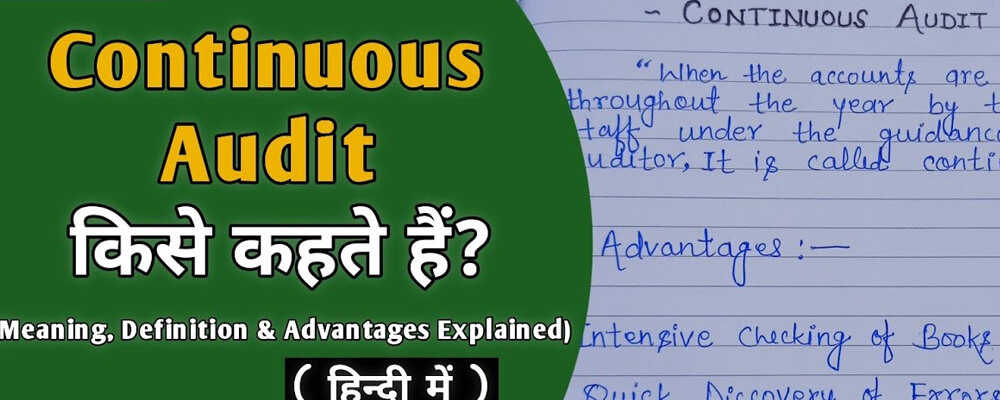
In a continuous audit, audit work is carried out throughout the year at regular or irregular intervals. Large-scale organizations often require continuous monitoring of their financial activities. Monthly or quarterly reviews help management stay updated on performance and make timely decisions.
Continuous audit is especially useful where there are frequent cash transactions or weak internal control systems. Although it may be costly, it helps reduce the risk of fraud and errors and ensures timely preparation of accounts.
Why Continuous Auditing is Important?
Continuous auditing enables organizations to monitor financial activities on an ongoing basis rather than waiting until the end of the accounting period. This approach helps identify accounting errors, fraud risks, and weaknesses in internal controls at an early stage, allowing management to take corrective action promptly.
Continuous auditing also improves the quality and efficiency of the audit process by distributing audit work throughout the year. It reduces the pressure associated with year-end audits, strengthens risk management, and provides more reliable financial information for decision-making.
Continuous Audit Definition
1. Definition by R. G. Williams
R. G. Williams defines continuous audit as an audit in which the auditor or audit staff is engaged in checking accounts throughout the year or attends at regular or irregular intervals during the accounting period.
2. Definition by Walter W. Bigg
Walter W. Bigg explains that continuous audit exists when a member of the audit staff is continuously involved in checking accounts throughout the financial year or visits frequently during the year.
3. Definition by R. Howard
R. Howard defines continuous audit as audit work conducted throughout the financial year but not limited to a specific accounting period like interim audit.
In continuous audit, the auditor examines accounts during the financial year rather than waiting until the end. This approach allows early detection of errors and fraud.
It is commonly used in large organizations, companies with heavy transaction volumes, or businesses with weak internal controls. Continuous audit also helps management in declaring dividends during the year and making timely financial decisions.
Although there may be conflicts between audit and accounting staff, experienced auditors can manage such situations effectively.
Characteristics of Continuous Audit
1. Work Throughout the Year
Audit work is carried out continuously during the financial year rather than at the end.
2. Multiple Visits
The auditor makes several visits to the organization to review accounts.
3. Surprise Visits
The auditor may conduct unannounced visits to ensure accuracy and prevent fraud.
4. Management Coordination
The timing of audit work may be planned in coordination with management.
5. Year-End Verification
Final verification of assets and liabilities is completed at the end of the financial year.
6. Suitability
Continuous audit is most suitable for large and multinational companies.
When Is a Continuous Audit Most Appropriate?
This section is highly recommended because it explains the practical application of continuous auditing.
Continuous audits are most appropriate for large organizations, financial institutions, multinational companies, government agencies, and businesses that process a high volume of financial transactions.
They are particularly useful where management requires regular financial reporting, strong internal controls, and ongoing assurance regarding compliance and risk management. Organizations with computerized accounting systems benefit most because audit activities can be integrated with automated monitoring tools.
Advantages of Continuous Audit
Continuous audit provides several benefits that improve efficiency, accuracy, and control over financial records.
1. Detailed Checking
Continuous audit allows thorough and regular checking of transactions. Audit staff examine records throughout the year, ensuring accuracy.
2. Early Location of Errors
Errors can be identified at an early stage because transactions are checked soon after they are recorded.
3. Completion of Accounts
Continuous audit encourages timely completion of accounting records, making finalization easier at year-end.
4. Interim Dividend
It helps management prepare interim accounts for declaring dividends during the year.
5. Moral Check
Continuous audit creates discipline among employees. Frequent checking reduces the chances of fraud.
6. Auditor’s Advice
The auditor can provide suggestions during the year, allowing management to correct weaknesses immediately.
7. Convenience for Auditor
Audit work is distributed over the year, reducing pressure on audit staff during peak periods.
8. Regular Staff Behavior
Accounting staff maintain records regularly, as they are aware of continuous supervision.
9. Sufficient Time
Auditors have enough time to examine complex matters and reach accurate conclusions.
10. Check on Fraud
Continuous audit helps prevent fraud by reducing the time gap between recording and checking transactions.
11. No Missing Entries
All transactions are recorded properly because records are reviewed regularly.
12. Early Correction of Errors
Errors can be corrected immediately after detection, improving the accuracy of accounts.
13. Prompt Filing of Returns
Accounts are ready on time, allowing organizations to file returns promptly.
14. Surprise Visits
Unexpected visits by auditors keep employees alert and reduce fraudulent activities.
15. Up-to-Date Records
Continuous audit ensures that accounting records are always current and ready for use.
16. Even Workload
Work is evenly distributed throughout the year, reducing stress and errors.
17. Early Meetings
Audited accounts are available earlier, allowing timely meetings of shareholders.
18. Dividend Payments
Continuous audit enables quick preparation of accounts, allowing management to declare dividends without delay.
Disadvantages of Continuous Audit
Despite its advantages, continuous audit has certain limitations.
1. Not Suitable for Small Business
Small businesses with limited transactions do not require continuous audit, making it unnecessary and burdensome.
2. Change in Figures
Accounting staff may alter figures after audit checks, which can create confusion.
3. Client Work Disturbance
Audit activities may interrupt the regular work of accounting staff, as records are frequently examined.
4. Staff Intimacy
Close interaction between audit and accounting staff may lead to bias or lack of independence.
5. Missing Link
Unresolved queries may be forgotten or left incomplete, affecting audit continuity.
6. Costly
Continuous audit involves high costs, making it difficult for many organizations to afford.
7. Low Income for Auditors
Audit staff may remain engaged with one client for a long time, reducing opportunities for other assignments.
Precautions of Continuous Audit
To ensure the effectiveness of continuous audit, certain precautions must be taken.
1. No Erasing of Figures
Figures should not be altered after audit checks. Surprise checks help maintain accuracy.
2. No Pending Questions
All queries should be resolved immediately to avoid confusion later.
3. Proper Balancing
Totals and balances should be finalized regularly to prevent manipulation.
4. Complete Checking
Audit work should be completed in one session whenever possible to maintain continuity.
5. Notes Preparation
Detailed notes should be maintained to prevent changes in recorded data.
6. Use of Tick Marks
Special audit symbols should be used and kept confidential from accounting staff.
7. Avoid Friendships
Auditors should maintain professional distance from accounting staff to ensure independence.
8. Irregular Intervals
Audit visits should be conducted at irregular intervals to prevent planned fraud.
Continuous Audit vs Interim Audit vs Final Audit
| Feature | Continuous Audit | Interim Audit | Final Audit |
|---|---|---|---|
| Timing | Throughout the year | During the financial year | After year-end |
| Frequency | Regular and ongoing | One or more scheduled reviews | Once after year-end |
| Coverage | Continuous examination | Partial accounting period | Complete financial year |
| Main Objective | Ongoing monitoring and early detection | Reduce year-end workload | Express the final audit opinion |
| Best For | Large organizations with frequent transactions | Medium to large organizations | All organizations requiring annual audits |
Example of a Continuous Audit
A multinational retail company uses a cloud-based accounting system that records thousands of transactions daily. Internal auditors review financial records every month, examine unusual transactions, evaluate inventory controls, and monitor compliance with company policies. Because auditing occurs continuously, management quickly identifies accounting errors and control weaknesses, allowing corrective action before the annual financial statements are prepared.
Frequently Asked Questions (FAQs)
What is a continuous audit?
A continuous audit is an auditing approach in which financial records and internal controls are examined regularly throughout the accounting period.
Why is a continuous audit conducted?
It helps identify errors, fraud, and control weaknesses early while improving the efficiency of the audit process.
What is the difference between a continuous audit and an interim audit?
A continuous audit is performed regularly throughout the year, whereas an interim audit is conducted at one or more specific times before year-end.
Which organizations benefit most from continuous audits?
Large businesses, banks, multinational corporations, and organizations with frequent financial transactions benefit most from continuous auditing.
How has technology improved continuous auditing?
Technology enables auditors to monitor financial transactions in real time using AI, data analytics, cloud accounting systems, and automated audit software.
Conclusion
Continuous auditing is an effective auditing approach that enables organizations to examine financial transactions and internal controls throughout the accounting period. By identifying errors, fraud risks, and operational weaknesses at an early stage, continuous audits improve financial reporting, strengthen internal controls, and reduce audit risks.
As businesses increasingly adopt digital accounting systems and automated financial processes, continuous auditing has become an essential tool for maintaining financial accuracy and supporting effective corporate governance.
Organizations that implement continuous auditing are better equipped to manage risks, improve decision-making, and maintain stakeholder confidence in an increasingly complex business environment.
See Also: Purpose of Audit Program