
A promissory note is one of the most important negotiable instruments used to record a promise to repay money. It is commonly used in business transactions, personal lending arrangements, and commercial finance to provide written evidence of a debt and the borrower’s obligation to repay it. Understanding promissory notes is essential for students of business law, banking, commerce, finance, and accounting.
A promissory note is a written and unconditional promise made by one person to another, undertaking to pay a specified sum of money either on demand or at a fixed or determinable future time, subject to the applicable legal requirements.
Promissory Note Definition
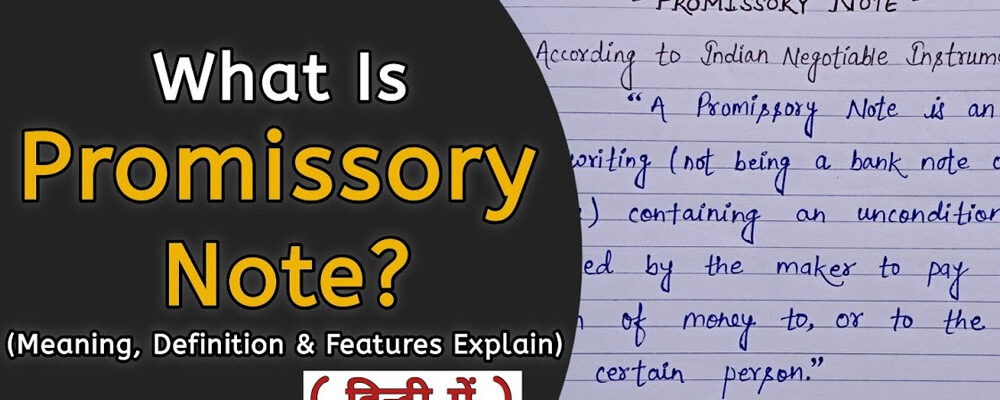
According to Section 4 of the Negotiable Instruments Act:
“A promissory note is an instrument in writing, not being a bank note or a currency note, containing an unconditional undertaking, signed by the maker, to pay a certain sum of money to a certain person or to their order or to the bearer.”
What is a Promissory Note
A promissory note is a written promise made by one person (the maker) to another person (the payee), agreeing to pay a specific sum of money either on demand or at a fixed future time.
Unlike a bill of exchange, it contains a promise to pay, not an order.
Why is a Promissory Note Important?
A promissory note provides written evidence of a debt and clearly records the borrower’s promise to repay a specified amount. It helps reduce misunderstandings between parties, supports commercial lending and borrowing, and provides legal certainty in financial transactions. Businesses, financial institutions, and individuals frequently use promissory notes to document repayment obligations.
Example:
A small business borrows funds from a supplier to purchase inventory. Instead of making immediate payment, the business signs a promissory note promising to repay the agreed amount within six months. The document records the repayment terms and provides written evidence of the debt, giving both parties greater certainty about their financial arrangement.
Common Types of Promissory Notes
| Type | Purpose |
|---|---|
| Demand Promissory Note | Payable whenever the payee demands payment |
| Time Promissory Note | Payable on a specified future date or after a specified period |
| Commercial Promissory Note | Used in business and commercial transactions |
| Personal Promissory Note | Used between individuals for private lending arrangements |
| Secured Promissory Note | Supported by collateral offered by the borrower |
| Unsecured Promissory Note | Based solely on the borrower’s promise to repay |
Essential Features of Promissory Note
The following are the key features that make a promissory note valid:
1. In Writing
A promissory note must always be in written form. A verbal promise is not valid under law.
2. Promise to Pay
It must contain a clear promise to pay. It cannot be a request or an order.
3. Unconditional Promise
The promise to pay must be unconditional. Any condition attached will make the instrument invalid.
4. Signed by the Maker
The maker must sign the document. If the maker cannot sign, a thumb impression may be used.
5. Fixed Amount
The amount payable must be certain and clearly defined. Vague statements about payment are not acceptable.
6. Payable in Money Only
The payment must be made only in money. It cannot be settled in goods, services, or any other form.
7. Payment Period
The promissory note must specify when payment will be made:
- On demand
- Or at a fixed or determinable future time
8. Maker Must Be Certain
The maker must be clearly identified. There can be one or more makers, and they may be liable jointly or jointly and severally.
9. Payee Must Be Certain
The payee must be a specific person. The amount cannot be payable to the maker himself.
10. Place and Date
The place and date are usually mentioned. However, they are not essential for the legal validity of the note.
Parties to a Promissory Note
| Party | Role |
|---|---|
| Maker | The person who promises to pay the money |
| Payee | The person who is entitled to receive payment |
Specimen of a Promissory Note
Below is a simple example of how a promissory note may look:
Rs. ________
Place: Bahawalpur
Date: January 1, 2020
Three months after date, I promise to pay M. Saeed Khan or order the sum of Rupees One Thousand only, for value received.
Stamp
Signature:
Saeed Khan
Principal, G.C.C. Multan
Sd/- N.K. Niazi
Advantages and Limitations of Promissory Notes
Advantages
- Provide written evidence of a debt.
- Clearly define repayment obligations.
- Support business and personal lending.
- Help reduce disputes between parties.
- Recognised under negotiable instruments law in many jurisdictions.
Limitations
- Must comply with applicable legal requirements.
- Recovery may require legal action if the borrower defaults.
- Some financial transactions require more detailed contractual documentation.
- Legal rules governing promissory notes differ across jurisdictions.
Frequently Asked Questions (FAQs)
What is a promissory note?
A promissory note is a written and unconditional promise by one person to pay a specified sum of money to another person according to agreed terms and the applicable legal framework.
Who are the parties to a promissory note?
The two principal parties are the maker (who promises to pay) and the payee (who receives payment).
What are the main types of promissory notes?
Common types include demand, time, commercial, personal, secured, and unsecured promissory notes.
Why is a promissory note important?
It creates written evidence of a debt, clarifies repayment obligations, and provides greater certainty in financial transactions.
What is the difference between a promissory note and a bill of exchange?
A promissory note contains a promise by the maker to pay, whereas a bill of exchange contains an order directing another party to make payment.
Conclusion
A promissory note is one of the most important negotiable instruments used to document borrowing and repayment obligations. By providing a written promise to pay, it promotes clarity, accountability, and confidence in business and financial transactions. Understanding its definition, features, parties, and types is essential for students of business law, banking, finance, and commerce.
Although modern financial systems increasingly rely on electronic documentation, promissory notes remain an important legal concept and continue to be used in many lending and commercial arrangements. A sound understanding of promissory notes also provides the foundation for studying related negotiable instruments such as bills of exchange and cheques.
See Also: What is Dishonour of Cheque | Reasons for Dishonour of Cheque