
Economics is a social science that studies how individuals, businesses, governments, and societies make choices when resources are limited but human wants and needs compete for those resources. It examines how goods and services are produced, distributed, exchanged, and consumed, as well as how incentives, prices, institutions, and public policies influence economic decisions.
At the heart of economics is the problem of scarcity. Because resources such as time, labour, land, capital, and natural resources are limited, choices must be made about how they should be used. Every choice involves trade-offs and an opportunity cost, the value of the next-best alternative that is given up.
Why Is Economics Important?
Economics helps people understand how choices are made when resources are limited. It provides tools for analysing consumer decisions, business production, prices, employment, inflation, economic growth, international trade, and government policy.
Understanding economics also helps explain why choices involve trade-offs. Individuals must decide how to use their income and time, businesses must decide how to allocate resources, and governments must choose among competing priorities such as education, healthcare, infrastructure, and other public services. Scarcity makes these choices unavoidable.
Example of Economics
Suppose a local government has a limited annual budget and must decide whether to spend additional funds on schools, healthcare facilities, or public transportation.
Because the budget is limited, it cannot fully fund every project. Choosing one option means giving up some of the benefits that could have been obtained from another option.
Economics helps analyse these choices by considering scarcity, opportunity cost, incentives, expected benefits, distributional effects, and the efficient use of available resources.
What is Economics | Different Definitions Of Economics
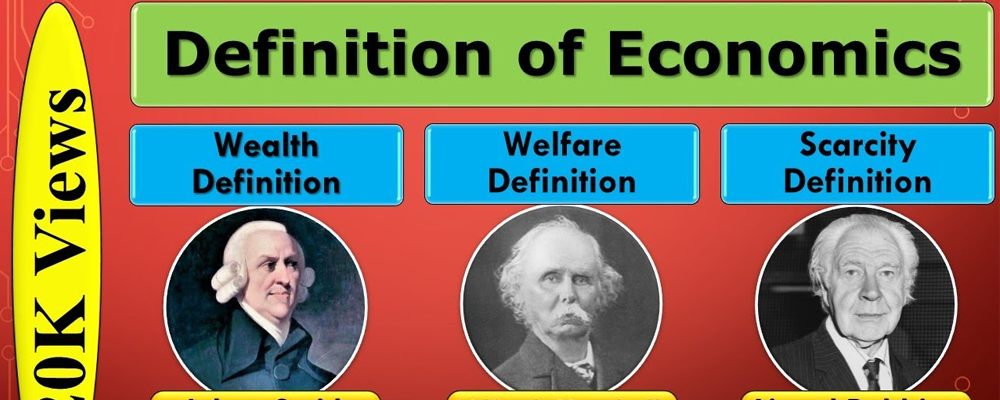
There are three well-known definitions of economics.
- Definition of economics given by the Classical School of thought led by Adam Smith
- Definition of economics presented by the Neo-Classical school of thought led by Alfred Marshall
- Definition of economics by Lionel Robbins
Definition of Economics Adam Smith
Adam Smith wrote a book in 1776 entitled “The wealth of Nations”. He discussed the word ‘Wealth ‘through its four aspects i.e. production of wealth, exchange of wealth, distribution of wealth and consumption of wealth.
See Also: What is the Nature & Scope of Economics
This clearly means that, according to Adam Smith, Economics is a science of wealth. To analyze this definition we will discuss the word ‘Wealth’ and its four aspects. Wealth means goods and services transacted with the help of money.
It is a matter of common observation that the transactions of goods and services (wealth) take place in our day-to-day lives.
But the question is: Why and how is the transaction of goods and services taking place? To know the answer to this question we are required to look into the four aspects of wealth.
-
Production of Wealth
This means the production of goods and services by combining four factors of production i.e. land, labour, capital and organization or entrepreneurship.
The land is the natural resource such as soil, sea, minerals, livestock, forests etc. Labour is the mental or physical work which is done for the sake of reward.
See Also: Economics Notes in PDF Free Download
Capital means manmade resources which help to produce goods and services, whereas organization is the act of combining four factors of production to producing and marketing of the goods and services for of profit. Hence, production of wealth means the production of goods and services.
-
Exchange of Wealth
Entrepreneurs usually produce more goods and services. Why they do so? Simply to get surplus produce exchanged in the market with the surplus goods and services produced by others.
The process of exchanging of wealth continues throughout the year and’ as a result, people get the goods and produced for each other. This enables everyone in the society to satisfy his multiple wants.
-
Distribution of Wealth
As a result of an exchange of wealth in a falls to a lot of each individual or a section of society is called his or its share in the national wealth produced in a year.
If the share of certain section of a society in the wealth is bigger than that of others this will be the unequal distribution of wealth in
If all sections of the society are enjoying all goods and services being produced in the country.
-
Consumption of Wealth
The ultimate objective of production, exchange and distribution is the consumption of wealth. When people get their share of the national product they use it to satisfy their wants.
Hence, the using up of the utility of goods and services for the satisfaction of wants is known’s as the consumption of wealth.
Thus, from the above explanation of wealth and its four aspects, it becomes clear that Adam Smith held the view that Economics studies the wealth of a nation or the goods and the services available to the society.
Besides this, he also explains as to why and how wealth is produced, exchanged, distributed and consumed.
Definition of Economics by Alfred Marshall
Marshall is a well-known economist. He was behind Smith and for him all the way, approximately hundred twenty years after Smith’s book on Economics.
Alfred Marshall wrote a book in Cambridge which was entitled ‘Principles of Economics’. Marshall defined Economics as an instrument to remove the doubts of the people.
See Also: Economics is a Science as Well as an Art
He stated, “Economics is the study of mankind in the everyday business examines that part of individual and social action which is most closely connected with the attainment and use of the material requisites of well-being”
From the definition, we are able to achieve three main points:
(i).The ordinary business of life or Economics as a social science
(ii). Attainment and use of material requisites or production and consumption of wealth
(iii).Well-being or welfare of the society
-
Ordinary Business of Life Or Economics as a Social Science
According to Marshall, Economics studies the economic behavior of the people living in society. Economic activities of the people outside the society are not, therefore, considered in the study of Economics.
Hence Economics does not study the isolated individuals or any ‘Robinson Crusoe’. By this, he shows that Economics is a social science.
-
Attainment and use of material requisites or production and consumption of wealth
In the ordinary business of life, human beings perform different types of activities such as political activities, sports activities, and economic activities, moral and religious activities.
Of all these activities of ordinary life, Economics studies only those activities which are related to the attainment and use of material requisites or, in other words, the Production and consumption of wealth. So far he is the same view as that of Adam Smith that Economics is a science of wealth.
-
Well Being Or Welfare of the Society
According to Marshall, the Objective of the study of Economics is to promote the material welfare of the people. To Marshall, Economics focuses on material aspects of life and therefore studies material requisites of well-being.
Hence, according to him, Economics does not regard wealth to be the goal Of all human activities. Instead, it is only a mean to achieve an end and that end is the economic welfare of the people or the raising up of the standard of living of the people, Particularly of the poor, so that they may lead a better economic life.
Definition Of Economics by Robbin
Lionel Robbins says, “Economics is the science which studies human behavior as a relationship between (multiple) ends and scarce means which have alternative uses. This definition points the problem of scarcity and choice in the economic life of the people. Three main points definition are:
(i).Multiple ends
(ii).Scarce means.
(iii).Alternative Uses.
-
Multiple Ends
Multiple ends mean a limit to wants’ and human wants unlimited. They keep on rising or they rise again and again. This means that they do not to an end even if they are satisfied.
For example, we take food in the morning and we need it again in the evening. Same is the case of wants to a radio, T. V. and furniture etc.
See Also: What is the Nature & Scope of Economics
We always want to replace them with the new and better ones. Since human wants are unlimited, one is compelled to choose between more urgent and less urgent wants which makes Economics a science of choice.
Hence the multiplicity of ends calls for ceaseless efforts for their satisfaction. Therefore, never-ending cycle of economic activities moves on.
-
Scarce Means
There may be no limit to human wants, but the means to satisfy them are definite. The means of resources can be divided into two parts.
Firstly, the resources in the production sector of the economy i.e. land, labour, capital and entrepreneurship are quite limited because the prices of these four factors of production are determined in the market.
Secondly, the consumer goods and services produced as a result of the combination of the four factors Of production are also limited because they are also priced in the market.
This means that resources are limited in the sense that one cannot have as many goods and services as he wishes for the satisfaction of wants.
There is definitely a limit to it. Money incomes represent command on the real resources available in the form of goods and services.
Higher the income, higher will be the availability of real resources and vice versa. Since incomes are always limited, monetary resources are also limited.
-
Alternative Uses
The third point gathered from Robbins definition is the ‘alternative’ use of resources. What Robbins meant to say is that there are many ways of using the resources.
It is always up to the person concerned to give priority to his/her basic wants.
For example, a person has got $1000. With this amount of money, he is able to do anything within this limit. He can buy clothes, entertain friends or dine outside with his family.
But, being a rational human being, he will choose the most optimum use of his limited resources. Supposing, he buys clothes only and postpones the fulfillment of all other wants.
This would mean that he has satisfied his want for clothes as an alternative to all other wants which could have been satisfied by an expenditure of $1000.
This is exactly the way all human beings pass their life. It gives a clear image of the economic life of the people who are always faced with the problem of scarcity of resources and choice between ends and are forced to make the alternative use of resources.
Definitions Comparison Table
This is essential for this article.
| Economist | Main Emphasis | Traditional Label | Key Contribution | Main Limitation |
|---|---|---|---|---|
| Adam Smith | Wealth and production | Wealth Definition | Highlighted production and national prosperity | Too narrow if interpreted as wealth alone |
| Alfred Marshall | Human material welfare | Welfare Definition | Connected wealth with human well-being | Material/non-material distinction is difficult |
| Lionel Robbins | Scarcity and choice | Scarcity Definition | Focused on scarce resources with alternative uses | Does not by itself capture every modern concern about institutions, growth, inequality, externalities, etc. |
Microeconomics vs Macroeconomics
This creates an excellent internal-linking opportunity.
| Microeconomics | Macroeconomics |
|---|---|
| Individual consumers | Whole economy |
| Individual firms | National output |
| Particular markets | Inflation |
| Prices of specific goods | Unemployment |
| Consumer choice | Economic growth |
| Firm production decisions | Economy-wide policy |
Definition of Economics | What is Economics | PDF Free Download |
Frequently Asked Questions
What is economics?
Economics is a social science that studies how individuals, businesses, governments, and societies make choices when resources are scarce and have competing uses.
What is the central problem of economics?
The central economic problem is scarcity: available resources are limited relative to the many purposes for which people and societies would like to use them.
What are the three traditional definitions of economics?
Introductory textbooks commonly describe Adam Smith’s approach as the wealth definition, Alfred Marshall’s as the welfare definition, and Lionel Robbins’ as the scarcity definition. Your current article is already organised around these three approaches.
What is scarcity in economics?
Scarcity exists when available resources are insufficient to satisfy all competing wants and uses, making choice and resource allocation necessary.
What is opportunity cost?
Opportunity cost is the value of the next-best alternative given up when a choice is made.
What is the difference between microeconomics and macroeconomics?
Microeconomics examines individual consumers, firms, and markets, while macroeconomics studies the overall economy, including output, employment, inflation, and economic growth.
Why is economics important?
Economics helps explain how scarce resources are allocated, why individuals and organisations make particular choices, and how those choices affect production, consumption, markets, public policy, and living standards.
Conclusion
Economics has evolved from an early emphasis on wealth to broader concerns with welfare, scarcity, choice, incentives, and resource allocation. Adam Smith’s work highlighted the creation and distribution of wealth, Alfred Marshall emphasised human welfare, and Lionel Robbins placed scarcity and choice at the centre of economic analysis.
Modern economics combines these historical insights while studying how individuals, businesses, governments, and societies make decisions and how those decisions influence markets and economy-wide outcomes. Because resources are scarce and have alternative uses, every economic choice involves trade-offs and opportunity costs. Understanding these principles provides the foundation for studying both microeconomics and macroeconomics.