
Auditing plays a vital role in ensuring the accuracy and reliability of financial information. According to Walter B. Meigs, auditing standards are authoritative rules used to measure the quality of performance. These standards guide auditors in carrying out their responsibilities effectively.
The functions of auditing represent the key responsibilities of an independent auditor. These functions help in verifying financial records, detecting errors or fraud, and ensuring that financial statements present a true and fair view.
Why are the Functions of Auditing Important?
The functions of auditing are important because they help organizations maintain accurate financial records, comply with legal requirements, and safeguard organizational assets. Through systematic examination and evaluation, auditors identify errors, irregularities, and weaknesses in financial reporting and internal controls, enabling management to take corrective action.
Effective auditing functions also improve stakeholder confidence by ensuring that financial statements present a true and fair view of the organization’s financial position. As businesses become more complex, auditing has become an essential tool for promoting accountability, transparency, and good corporate governance.
See Also: Basic Principles of Auditing
Major Functions of Auditing
| Function | Purpose |
|---|---|
| Verification | Confirm the accuracy of financial records |
| Detection of Errors and Fraud | Identify material misstatements and irregularities |
| Evaluation of Internal Controls | Assess the effectiveness of control systems |
| Compliance | Ensure adherence to laws, regulations, and accounting standards |
| Reporting | Provide an independent audit opinion |
| Advisory Function | Recommend improvements to financial and operational processes |
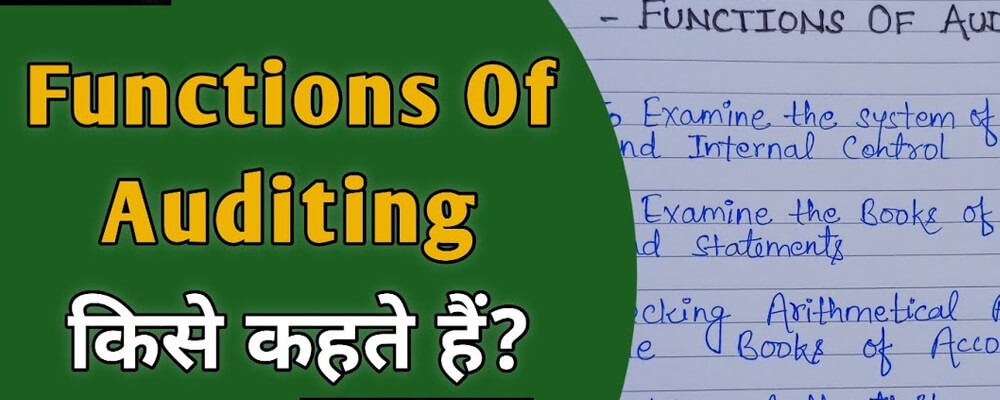
The important functions of auditing are discussed below in detail. Each function contributes to maintaining transparency, accountability, and trust in financial reporting.
1. Accounting System
The first function of auditing is to study and understand the accounting system of the organization. An accounting system is a structured process through which transactions are identified, recorded, classified, summarized, and reported.
It involves recognizing transactions, calculating amounts, posting entries, and preparing financial reports. The auditor must understand how this system operates in order to determine the nature, timing, and extent of audit procedures.
A proper understanding of the accounting system allows the auditor to identify potential risks and areas that require detailed examination.
2. Internal Control
Internal control refers to the processes and procedures established by management to ensure that policies are followed and accounting principles are applied correctly.
It helps safeguard assets, prevent and detect errors and fraud, and ensure timely preparation of reliable financial statements. The auditor evaluates the effectiveness of internal controls to determine how much reliance can be placed on them.
If internal controls are strong, the auditor may reduce the extent of detailed testing. However, if controls are weak, more extensive audit procedures are required.
3. Vouching
Vouching is one of the most important functions of auditing. It involves examining the documents that support business transactions recorded in the books of accounts.
The auditor checks details such as date, amount, and authenticity of transactions. Since all entries are based on supporting vouchers, this process ensures that recorded transactions are genuine and accurate.
Vouching helps in detecting errors, omissions, and fraudulent activities in financial records.
4. Arithmetic Accuracy
Checking arithmetic accuracy is another essential function of auditing. The auditor verifies calculations in account books, ledgers, and financial statements.
This includes checking totals, balances, and computations to ensure correctness. Any mathematical errors or inconsistencies can be identified during this process.
By ensuring arithmetic accuracy, the auditor helps present a true and fair view of financial statements and enables management to correct any mistakes.
5. Capital and Revenue
The auditor is responsible for distinguishing between capital and revenue items. This classification is important for determining the correct financial position and performance of the business.
Revenue items relate to income and expenses of the current period, while capital items relate to long-term assets and liabilities. Proper classification ensures that profits are not overstated or understated.
The auditor also ensures that expenses and incomes are correctly allocated between current and future periods.
6. Verification of Assets
Verification of assets is a key function of auditing. It involves confirming the existence, ownership, value, and possession of assets.
The auditor examines documents such as purchase invoices and ownership records. He may also physically verify assets to ensure they actually exist.
If assets are pledged as security for loans, the auditor must verify such details. This process ensures that assets are properly recorded and free from misstatement.
7. Verification of Liabilities
The auditor also verifies liabilities recorded in the books of accounts. Management must provide a written confirmation that all liabilities have been included in the financial statements.
The auditor may send confirmation letters to creditors to verify outstanding balances. This ensures that liabilities are complete and accurately recorded.
Proper verification prevents understatement or omission of liabilities.
8. Valuation of Assets
Valuation of assets involves assessing whether assets are recorded at appropriate values in accordance with accounting principles.
While management determines the value of assets, the auditor critically examines these valuations. In some cases, the auditor may seek assistance from technical experts.
Proper valuation ensures that financial statements reflect realistic asset values.
9. Valuation of Liabilities
The auditor also examines the valuation of liabilities. These are recorded in the balance sheet based on agreements and obligations.
The auditor verifies these values using accounting records and supporting documents. For contingent liabilities, independent expert opinion may be required.
This function ensures that liabilities are fairly stated and not understated or overstated.
10. Legal Requirement
The auditor must ensure that financial statements comply with relevant laws and regulations, such as Companies Ordinance 1984, Income Tax Ordinance 2001, and Stock Exchange Rules 1971.
He checks whether all legal requirements have been properly followed in the preparation of financial statements. Any non-compliance must be reported.
This function ensures that the organization operates within the legal framework.
11. Reporting
Reporting is the final and most important function of auditing. The auditor expresses his opinion on the financial statements in a written report.
If the auditor is satisfied that the financial statements present a true and fair view, he issues a clean report. If there are issues or limitations, he provides a qualified report.
The auditor’s report is important for stakeholders as it reflects the credibility and reliability of financial information.
Functions of Auditing and Their Benefits
| Auditing Function | Benefit to the Organization |
|---|---|
| Verification | Improves financial accuracy |
| Fraud Detection | Reduces financial losses |
| Internal Control Evaluation | Strengthens risk management |
| Compliance Review | Minimizes legal and regulatory risks |
| Audit Reporting | Increases stakeholder confidence |
| Advisory Services | Supports better management decisions |
Practical Example of Auditing Functions
A manufacturing company appoints an external auditor to examine its annual financial statements. During the audit, the auditor verifies accounting records, evaluates internal controls, identifies weaknesses in inventory management, and recommends improvements to reduce the risk of inventory shortages and financial misstatements.
The audit report provides assurance to shareholders that the financial statements fairly represent the company’s financial position. This example demonstrates how multiple auditing functions work together to improve financial reporting and organizational performance.
How Auditing Functions Support Corporate Governance
This section is highly recommended because it connects auditing with modern business management.
Effective auditing functions strengthen corporate governance by promoting transparency, accountability, and ethical financial reporting. Independent audits provide assurance that management is acting responsibly and that financial information can be trusted by investors, regulators, creditors, and other stakeholders.
Auditing also supports the board of directors and audit committees by identifying weaknesses in internal controls and recommending improvements that enhance organizational performance and risk management.
Frequently Asked Questions (FAQs)
What are the functions of auditing?
The functions of auditing include verifying financial records, detecting errors and fraud, evaluating internal controls, ensuring compliance, and reporting audit findings.
Why are the functions of auditing important?
They help organizations maintain accurate financial reporting, improve internal controls, and increase stakeholder confidence.
What is the primary function of auditing?
The primary function is to examine financial records and provide an independent opinion on whether the financial statements present a true and fair view.
How do auditing functions help prevent fraud?
Auditors evaluate internal controls, identify unusual transactions, and investigate material misstatements that may indicate fraud.
How has technology changed auditing functions?
Technology enables auditors to analyze financial data more efficiently through data analytics, AI, and automated audit tools.
Conclusion
The functions of auditing extend far beyond examining financial statements. They help organizations verify financial information, detect fraud, strengthen internal controls, ensure legal compliance, and improve overall corporate governance. Through these functions, auditing promotes transparency, accountability, and confidence in financial reporting.
As businesses continue to adopt advanced technologies and operate in increasingly complex regulatory environments, the functions of auditing have become even more important.
Organizations that effectively apply auditing principles are better equipped to manage risks, protect stakeholder interests, and achieve sustainable long-term success.
References