
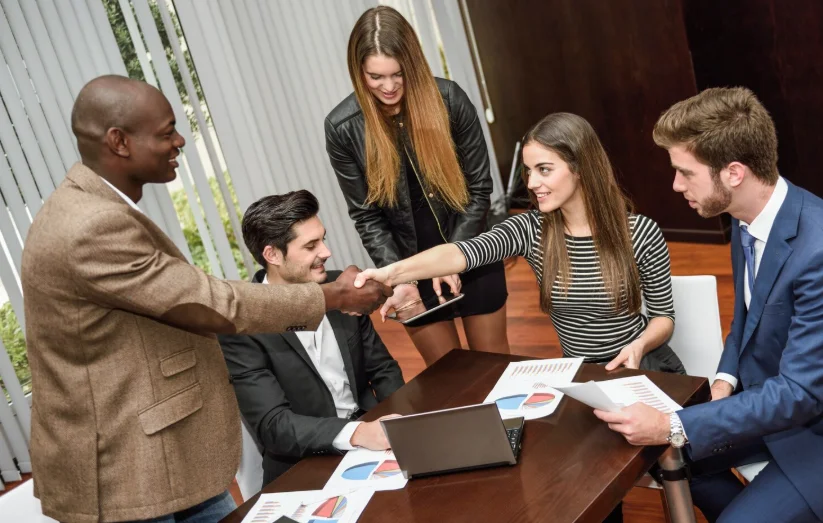

Group dynamics refer to the interactions, behaviors, and relationships that influence how individuals work together within a group. In organizations, effective group dynamics improve communication, encourage collaboration, enhance problem-solving, and increase overall productivity.
Understanding group dynamics enables managers to build stronger teams, resolve conflicts, improve employee engagement, and create a positive work environment. Organizations that effectively manage group interactions are better positioned to achieve their strategic objectives.
A group is a combination of two or more interdependent persons who interact with each other to achieve specific goals.
Common Types of Groups in Organizations
| Group Type | Primary Purpose |
|---|---|
| Formal Groups | Achieve organizational objectives |
| Informal Groups | Social interaction and support |
| Command Groups | Supervise operational activities |
| Task Groups | Complete specific assignments |
| Project Groups | Manage temporary projects |
| Interest Groups | Promote shared interests |
The group is broadly classified into the following two types which are:
-
Formal Group
-
Informal Group
Formal Group:
A formal group is considered to be a group that is formed by specific authorities within organizations, and they specifically design tasks & work assignments. The behavior executed by the members of such groups is directed toward the achievement of the identified objectives of the business organization.
Informal Group:
An informal group is the opposite of a formal group, which is formed automatically in a natural social way. The behavior shown by the members of an informal group circulates around common interests and friendship.
Formal Groups vs Informal Groups
| Formal Groups | Informal Groups |
|---|---|
| Created by management | Form naturally among employees |
| Have defined objectives | Develop through personal relationships |
| Follow organizational hierarchy | Operate outside formal structures |
| Support organizational goals | Provide social support and communication |
Why People Join Groups
There is no single reason that can be valid for explaining the fact of why people join groups. So there are a number of reasons which are as follows.
-
Security:
Because strength in numbers provides security, people join together as a group to feel stronger & resistant to threats. -
Status:
Another big reason for joining a group is the acquisition of status and recognition. People join a particular group that has a prestigious status, which becomes a symbolic part of the members of that group. -
Self-Esteem:
The feeling of self-worth is satisfied by joining a group & therefore people satisfy their self-esteem, which is accepted by the other members of that group. -
Affiliation:
The social needs of people are fulfilled by forming a group; that is why people love to join any group to satisfy their need for social relations & friendship. -
Power:
Another significant reason for joining a group is the reflection & representation of power that can be helpful for members to save themselves from illogical demands & to create favorable opportunities through group actions.
Goal Achievement:
The final reason for joining a group by people is to achieve certain goals that cannot be accomplished individually because they require diversified knowledge & skills.
Roles of Group:
Roles are linked with particular status & within organizations employees are obliged to play certain roles according to their assigned designations. Employees are expected to show certain patterns of behavior that are directly related to the accomplishment of the objectives of the organization. Each employee plays more than one role & sometimes it also creates role conflict.
Moreover, there are certain roles that are specified for groups & these roles are as follows:
-
Task-Oriented Roles
-
Relationship-Oriented Roles
-
Group Roles
Task-Oriented Roles:
Task-oriented roles are those roles that are executed for the accomplishment of a particular task. This is further divided into the following two types:
a) Initiator & Contributor Roles
b) Information Seeker & Provider Roles
Relationship-Oriented Roles:
Roles that are directed towards strengthening certain social relationships are called relationship-oriented roles. These roles are categorized into the following two types:
a) Encourager Roles
b) Harmonizer Roles
Individual Roles:
Individual roles are represented by the actions & behavior of single individuals. These roles are also classified as follows:
a) Blocker Roles
b) Joker Roles
Group Types and Their Organizational Benefits
| Group Type | Organizational Benefit |
|---|---|
| Formal Groups | Improved coordination |
| Informal Groups | Better employee relationships |
| Task Groups | Faster problem-solving |
| Project Groups | Efficient project completion |
| Command Groups | Clear supervision |
| Interest Groups | Stronger employee engagement |
Features of an Effective Group:
A group is said to be effective when it shows the following characteristics:
• The atmosphere of the group is relaxed, informal & comfortable.
• The tasks assigned to the members are well understood & accepted.
• The members of the group listen to each other & participate in the assigned tasks.
• The members of the group know the functions & operations of the whole group.
• The ideas & feelings are properly expressed by the members.
• Decisions are made through consensus.
• The disagreements & conflicts are based on methods or ideas, not personalities.
Example of Group Dynamics
Suppose a software development company creates a cross-functional project group to develop a new mobile application.
The group includes software developers, designers, marketing specialists, and quality assurance professionals. Initially, members experience communication challenges because of their different backgrounds and responsibilities. Through regular meetings, clear leadership, and collaborative problem-solving, the group develops trust and improves coordination.
As cooperation strengthens, productivity increases, project deadlines are met, and the organization successfully launches the new application.
This example demonstrates how positive group dynamics contribute to organizational success.
Benefits and Challenges of Group Dynamics
| Benefits | Challenges |
|---|---|
| Better teamwork | Communication barriers |
| Improved decision-making | Group conflicts |
| Greater innovation | Groupthink |
| Increased productivity | Unequal participation |
| Stronger employee engagement | Resistance to change |
Several factors affect group dynamics, including leadership style, communication, trust, organizational culture, group size, shared goals, and individual personalities. Positive group dynamics develop when members cooperate effectively, communicate openly, and support one another in achieving common objectives.
Managers play a critical role in fostering productive group behavior by encouraging participation, resolving conflicts, and promoting mutual respect among team members.
Frequently Asked Questions (FAQs)
What are group dynamics?
Group dynamics refer to the interactions, behaviors, and relationships that influence how individuals work together within a group.
What are the main types of groups in organizations?
The main types include formal groups, informal groups, command groups, task groups, project groups, and interest groups.
Why are group dynamics important?
Effective group dynamics improve communication, teamwork, decision-making, employee engagement, and organizational performance.
What is the difference between formal and informal groups?
Formal groups are created by management to achieve organizational objectives, while informal groups develop naturally through employee relationships.
How can managers improve group dynamics?
Managers can improve group dynamics by promoting communication, encouraging collaboration, resolving conflicts, defining clear goals, and supporting team development.
Conclusion
Group dynamics play a vital role in determining how employees interact, communicate, and collaborate within an organization. Positive group dynamics promote teamwork, improve problem-solving, strengthen employee relationships, and contribute to higher organizational performance. Understanding the different types of groups helps managers assign responsibilities effectively and create productive work environments.
Although organizations may encounter challenges such as communication barriers, interpersonal conflicts, and unequal participation, these issues can be addressed through effective leadership, open communication, and team-building initiatives. By fostering healthy group dynamics, organizations can improve employee engagement, enhance productivity, and achieve their long-term business objectives.