
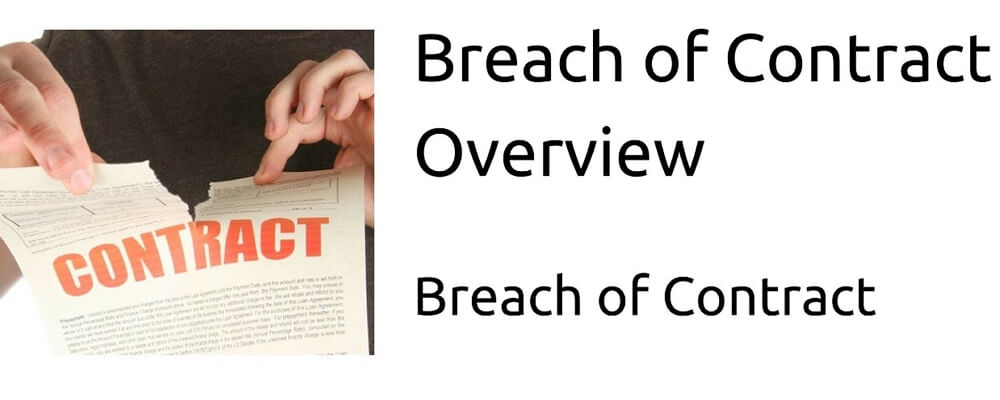

A contract creates legal obligations between parties, and both sides are expected to perform their agreed duties. However, situations may arise where one party fails or refuses to fulfill their obligations. This situation is known as a breach of contract. It is an important concept in contract law because it gives the affected party the right to seek legal remedies. Understanding breach of contract and its remedies helps individuals and businesses protect their interests and enforce their legal rights effectively.
What is Breach of Contract
Breach of contract means the violation or non-performance of the agreed terms by any party involved in a contract. When one of the contracting parties fails to perform their part of the obligation in a lawful contract, a breach occurs.
In simple terms, when a party breaks the contract or refuses to perform it, it is called a breach of contract. In such a case, the other party, known as the aggrieved party, has the legal right to take action against the defaulter and claim appropriate remedies.
Why is Breach of Contract Important?
The law relating to breach of contract protects the integrity of commercial transactions by ensuring that parties remain accountable for their contractual promises. It encourages businesses to honor agreements while providing legal remedies when obligations are not fulfilled.
Understanding breach of contract also helps organizations reduce legal risks, draft stronger agreements, and resolve disputes more effectively through negotiation or legal action where necessary.
Example of Breach of Contract
A supplier agrees to deliver manufacturing equipment to a factory by a specified date. The supplier fails to deliver the equipment without a lawful excuse, causing the factory to suspend production and incur financial losses. Depending on the governing law and the contract terms, the factory may seek damages, specific performance where appropriate, or other available remedies to protect its interests.
Types of Breach of Contract
| Type | Description |
|---|---|
| Actual Breach | Occurs when a party fails to perform on the due date or performs improperly |
| Anticipatory Breach | Occurs when a party indicates before the due date that they will not perform the contract |
| Partial Breach | Only part of the contractual obligation is not performed |
| Material (Fundamental) Breach | A serious breach that substantially defeats the purpose of the contract |
Remedies for Breach of Contract
| Remedy | Purpose |
|---|---|
| Damages | Compensate the injured party for proven losses |
| Specific Performance | Require the defaulting party to perform the contract where appropriate |
| Injunction | Prevent certain actions that would breach contractual obligations |
| Rescission | Cancel the contract and restore the parties, where permitted by law |
| Restitution | Prevent one party from being unjustly enriched at the expense of another |
Note: The availability of these remedies depends on the applicable law and the facts of each case.
When a contract is breached, the law provides several remedies to the aggrieved party. These remedies aim to compensate for the loss suffered and, in some cases, ensure the contract is properly performed.
1. Rescission of the Contract
Rescission means cancelling the contract. When one party fails to perform their obligations, the other party may rescind the contract and be released from all future obligations.
According to Section 75 of the Contract Act, a party who rightfully rescinds a contract is entitled to claim compensation for any loss or damage suffered due to the non-performance of the contract.
For example, if A promises to deliver 100 units of goods to B within 10 days for $1000, but A fails to deliver, B can refuse payment and also claim damages. This allows the aggrieved party to avoid further loss.
2. Claim for Damages
Claiming damages is the most common remedy for breach of contract. When one party breaches the contract, the other party can claim compensation for the loss or damage suffered.
According to Section 73 of the Contract Act, the party suffering from the breach is entitled to receive compensation from the party who has broken the contract.
For instance, if A agrees to sell goods worth $10,000 to B and later refuses to deliver when the market price rises to $20,000, B can claim damages for the loss of profit.
Damages are generally classified into two types: general damages and special damages.
3. General Damages
General damages refer to the loss that naturally arises from the breach of contract. These damages are the direct and immediate result of non-performance.
For example, if A agrees to sell goods to B for $500,000 and B pays a portion in advance, but A refuses to deliver the goods later, B can claim the amount paid and any reasonable profit that could have been earned.
These damages aim to place the aggrieved party in the same position as if the contract had been properly performed.
4. Special Damages
Special damages are those that are agreed upon by both parties at the time of making the contract. These damages are payable in case of breach and are usually predetermined.
For example, if A agrees to deliver goods to B and both parties agree that in case of default, the defaulter will pay $1000 as compensation, this amount is considered special damages.
These damages provide certainty and reduce disputes at the time of breach.
5. Specific Performance
In some cases, monetary compensation is not sufficient to cover the loss. In such situations, the court may order specific performance.
Specific performance means that the court compels the defaulting party to perform their contractual obligations as agreed.
For example, if A agrees to purchase a piece of land from B and B refuses to complete the sale, the court may order B to transfer the property to A.
This remedy is usually applied in cases involving unique goods or property.
6. Suit for Quantum Meruit
Quantum meruit means “as much as earned.” This remedy applies when one party has performed part of their obligation, but the contract is breached by the other party.
In such cases, the performing party has the right to claim payment for the work already done.
For example, if A agrees to buy 100 units of goods from B and pays for part of it in advance, but B refuses to complete the contract, A can claim the value of what has already been performed.
This ensures fairness and prevents unjust enrichment.
7. Suit for Injunction
An injunction is a court order that prevents a party from doing a specific act. It is a negative remedy used when a party violates a promise not to do something.
For example, if an actress agrees to work exclusively for one producer but later signs a contract with another, the court may issue an injunction preventing her from working with others during the contract period.
This remedy helps enforce negative obligations in a contract.
How Businesses Can Prevent Breaches of Contract
Businesses can reduce the likelihood of contractual disputes by drafting clear agreements, defining responsibilities precisely, monitoring contractual deadlines, maintaining effective communication, and documenting important decisions throughout the contractual relationship. Seeking legal advice before entering complex agreements can also help identify potential risks and strengthen contractual protection.
Frequently Asked Questions (FAQs)
What is a breach of contract?
A breach of contract occurs when one party fails to perform their contractual obligations without lawful justification.
What are the main types of breach?
The main types include actual breach, anticipatory breach, partial breach, and material (fundamental) breach.
What remedies are available for breach of contract?
Depending on the applicable law, remedies may include damages, specific performance, injunctions, rescission, and restitution.
What is the most common remedy?
Damages are generally the most common remedy because they compensate the injured party for proven losses resulting from the breach.
Can electronic contracts also be breached?
Yes. Electronic contracts are generally enforceable according to the applicable law, and breaches may give rise to the same or similar legal remedies as traditional contracts.
Conclusion
Breach of contract is a serious matter that affects the rights and obligations of the parties involved. When one party fails to perform their duties, the law provides several remedies to protect the aggrieved party. These remedies, such as rescission, damages, specific performance, quantum meruit, and injunction, ensure that justice is served and losses are compensated. Understanding these remedies allows individuals and businesses to take appropriate legal action and safeguard their interests effectively.
See Also: What is Discharge of Contract