
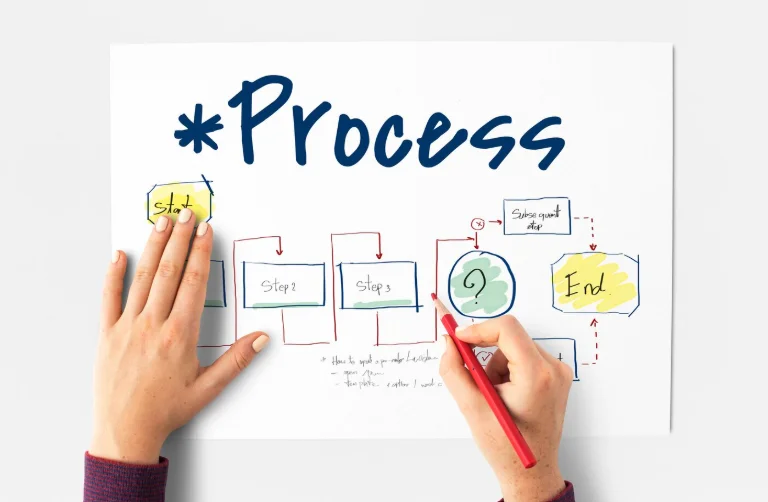

The marketing process is a systematic approach that organizations use to identify customer needs, create value, communicate effectively, and build long-term customer relationships. Rather than focusing only on selling products, the marketing process helps businesses understand their target markets and develop strategies that satisfy customers while achieving organizational goals.
Every successful organization follows a structured marketing process to research customer needs, develop products, determine appropriate pricing, choose effective distribution channels, promote products, and evaluate customer satisfaction. Understanding these steps enables marketers to make informed decisions and improve overall marketing performance.
This article explains the major steps involved in the marketing process, their importance, practical examples, and their role in achieving long-term business success.
Why the Marketing Process is Important
A structured marketing process helps organizations make informed decisions, understand customer needs, reduce business risks, and allocate resources more effectively. It also ensures that all marketing activities work together to create value for customers and support organizational objectives.
By following the marketing process, businesses can improve customer satisfaction, strengthen brand loyalty, and respond more effectively to changing market conditions.
Major Steps in the Marketing Process
| Step | Purpose |
|---|---|
| Market Research | Understand customer needs and market conditions |
| Market Segmentation | Divide the market into meaningful groups |
| Target Market Selection | Choose the most attractive customer segments |
| Positioning | Create a distinct market image |
| Marketing Mix Development | Develop product, price, place, and promotion strategies |
| Implementation | Execute marketing activities |
| Evaluation and Control | Measure results and improve performance |
-
Analysis of opportunities in the market
-
Selection of the target market
-
Development of marketing mix
-
Management of marketing efforts
Each of these steps is discussed below.
Analysis of Opportunities in the Market:
The first component of the marketing process is to analyze the market in order to find opportunities that should be availed. These opportunities are related to the needs and wants of customers that are not properly satisfied by competitors in the market.
A company that is initiating the marketing process focuses on opportunities that would be beneficial for long-run success so that its performance would be effectively improved. For this purpose, the company gets help from the Marketing Information System (MIS), which plays a significant role in providing useful information about the market.
The company also conducts effective market research that provides valuable information about customers, competitors, general trends, and any extraordinary changes occurring in the market that can be useful for the company. Finally, the company identifies potential opportunities from the collected information and splits the whole market into different segments.
These segments are based on factors like age group, geographical location, etc. The company evaluates each segment separately to check its potential in the light of its strengths and weaknesses. Finally, it selects the target market segment to proceed further.
Selection of the Target Market:
This is the most important step of the marketing process in which target customers are selected. For this purpose, the company conducts careful analysis of target markets in order to choose final customers. As it is obvious that a company does not satisfy the needs and wants of the whole market, it must divide the whole market into different segments and choose the segment that best matches its strengths and opportunities.
In this regard, there are certain concepts in this step of the marketing process.
Market Segmentation:
The process in which the whole market is split into different units of consumers, each unit having similar wants, characteristics, and behaviors which need different marketing mixes and strategies.
Market Targeting:
In this process, targeted segments of the total market are evaluated to ascertain the attractiveness of each segment so that one or two most suitable and potential segments should be selected and entered. The simple rule of selecting the target unit or segment is that it must provide an opportunity to the company to create potential customer value in the long run.
Another important rule is that a company has the option to satisfy the needs and wants of one or two segments. In this case, the company focuses on relevant segments and develops its products and strategies for them only. Such small segments are called “niches”.
The company also has another option to split the whole market into different segments and offer different products and marketing mixes to each segment of the market. But the most effective method is to focus on one or two segments and, after succeeding in those segments, further new segments should be targeted.
Market Positioning:
This concept relates to the positioning of a company’s product in the minds of customers as compared to competitors’ products. In other words, the company tries to maintain a clear and specific perception among customers about its products. When a company wants to position its product, it first specifies the competitive edge for which it offers competitive advantages to its target customers.
The whole marketing program of the company should concentrate on its identified positioning strategy. Positioning is effective when the company truly provides an efficient and competitive offering to customers in order to give them maximum value as compared to competitors’ offerings.
Development of Marketing Mix:
After setting a complete marketing strategy, the company is ready to initiate planning of its marketing mix.
Marketing Mix:
Marketing mix is composed of certain market variables that are combined by the company in order to generate a desired response in targeted segments.
In fact, the demand for a product is influenced by the use of certain marketing mix activities. The marketing mix is composed of the following four P’s.
-
Product means any offering (goods or services) to the market by the company.
-
Price means the money paid by customers to obtain the product.
-
Place means the efforts which ensure the availability of the product in the market to customers.
-
Promotion means all the efforts by the company that ensure the sale of products to customers through better provision of information about product advantages.
A company develops an effective marketing program in which a suitable combination of the marketing mix is blended so that they are efficiently coordinated into a useful program to provide greater customer value in order to accomplish the company’s objectives.
The 4P’s of the marketing mix are from the seller’s perspective. In certain cases, the 4C’s replace the 4P’s which are:
• Product means Customer Solution
• Price means Customer Cost
• Place means Convenience
• Promotion means Communication
Management of Marketing Efforts:
This is actually the action phase of developing a marketing program in which a suitable marketing mix is set for a target market. For the management of marketing efforts, four functions are adopted which are as follows.
-
Analysis of the Market in which the company identifies internal strengths and weaknesses along with external opportunities and threats.
-
Marketing Planning in which marketing plans or strategies are developed so that overall marketing objectives can be accomplished.
-
Marketing Implementation in which developed plans and strategies are practically implemented in order to achieve marketing objectives.
-
Marketing Control in which performance results of marketing plans and strategies are evaluated and necessary steps are taken to ensure accomplishment of overall marketing objectives of the company.
Marketing Process vs Marketing Strategy
This distinction is often confusing for students.
| Marketing Process | Marketing Strategy |
|---|---|
| Sequence of marketing activities | Long-term plan for achieving marketing objectives |
| Focuses on implementation | Focuses on planning and competitive positioning |
| Includes research, execution, and evaluation | Guides overall marketing direction |
| Continuous process | Strategic decision-making framework |
Practical Example of the Marketing Process
Suppose a company plans to introduce a new organic fruit juice.
The marketing team begins by conducting market research to understand customer preferences. They identify health-conscious adults as the target market and position the product as a premium, natural beverage. After developing an appropriate product, pricing, distribution, and promotional strategy, the company launches the product through supermarkets and online channels. Customer feedback and sales performance are then evaluated to improve future marketing activities.
This example demonstrates how each stage of the marketing process contributes to marketing success.
Marketing Process and Business Benefits
| Marketing Step | Business Benefit |
|---|---|
| Market Research | Better customer understanding |
| Segmentation | More effective targeting |
| Positioning | Stronger brand identity |
| Marketing Mix | Higher customer satisfaction |
| Implementation | Efficient marketing execution |
| Evaluation | Continuous improvement |
Frequently Asked Questions (FAQs)
What is the marketing process?
The marketing process is a series of activities that organizations follow to identify customer needs, create value, develop marketing strategies, deliver products or services, and build lasting customer relationships.
What are the main steps in the marketing process?
The major steps include market research, market segmentation, target market selection, positioning, marketing mix development, implementation, and evaluation.
Why is the marketing process important?
It helps organizations understand customers, improve marketing decisions, reduce risks, and achieve long-term business success.
What is the difference between the marketing process and marketing strategy?
The marketing process describes the sequence of marketing activities, while marketing strategy outlines the long-term plan for achieving marketing objectives and competitive advantage.
How has technology changed the marketing process?
Technology has improved customer research, personalization, digital communication, campaign measurement, and customer relationship management through data analytics and online platforms.
Conclusion:
The marketing process provides organizations with a structured approach for identifying customer needs, creating value, developing effective marketing strategies, and building long-term customer relationships. By following each stage—from market research to evaluation—businesses can improve customer satisfaction, strengthen brand positioning, and achieve sustainable growth.
In today’s digital and highly competitive marketplace, successful organizations continuously refine their marketing process by using customer insights, technology, and data-driven decision-making. Businesses that consistently apply an effective marketing process are better positioned to adapt to changing market conditions and maintain long-term success.
References: